
RFID systems come from the scientific field of Electromagnetic field theory. These systems use Electromagnetic waves to communicate between a reader and a tag.
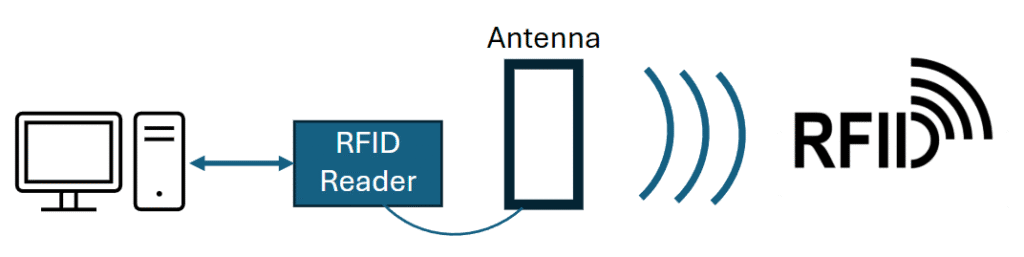
Electromagnetic Waves - RFID systems use radio waves, a type of electromagnetic radiation, to communicate between a reader and a tag.
These waves travel through the air at the speed of light and can pass through various materials (plastic, cardboard, etc.), depending on the frequency.
There are three principles of physics that impact how an RFID system behaves in your environment:
- Faraday’s Law: Time-varying magnetic fields induce electric current in a conductor
- Maxwell’s Equations: Govern how electromagnetic fields propagate and interact
- Resonance: Tag antennas are tuned to resonate at specific frequencies for efficient energy absorption
- Inverse Square Law: Describes how the power received by a tag decreases rapidly and non-linearly as the distance from the antenna increases.
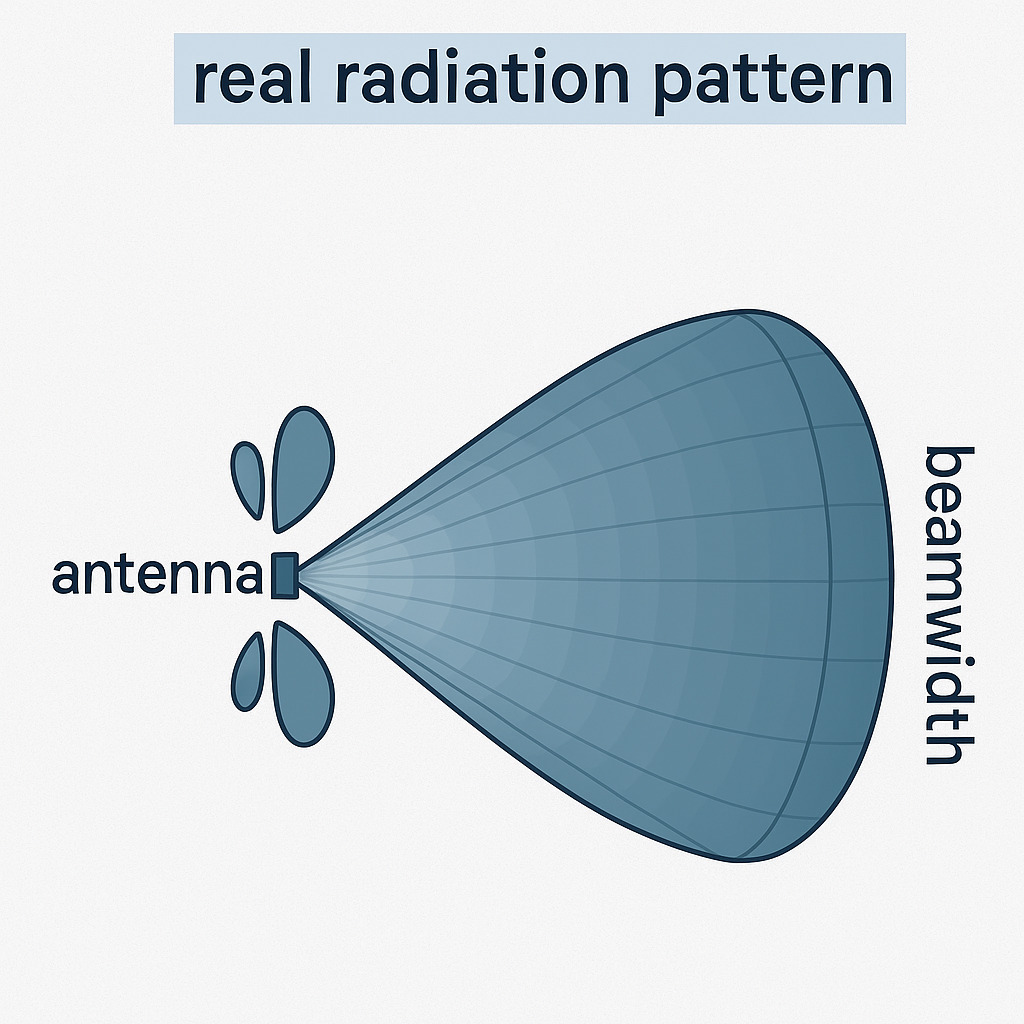
There are two primary types of communication used in RFID systems:
Near-Field (Inductive Coupling)
- Used by low-frequency (LF) and high-frequency (HF) RFID (e.g., 125 kHz or 13.56 MHz)
- Based on magnetic fields, similar to how a transformer works
- The RFID reader generates a changing magnetic field
- A coil in the tag picks up this field and generates a small current (via Faraday’s Law of Induction), powering the tag
- This allows communication within a few centimeters to 1 meter

Far-Field (Electromagnetic Coupling)
- Used by ultra-high frequency (UHF) RFID (e.g., 860–960 MHz)
- Based on radiative electromagnetic fields
- The RFID reader emits radio waves
- The tag’s antenna absorbs some of this energy (called backscatter)
- The tag modulates and reflects some of this signal back to the reader, essentially "echoing" the data
- Range: Up to 10+ meters (especially for active tags)